
Key takeaways
- Heated perchloric acid vapor condenses in cooler ductwork, dries out, and leaves perchlorate salts on duct walls, joints, fans and stacks.
- Some metal and organic perchlorates are highly sensitive. Heat, impact or friction during maintenance can set them off.
- NFPA 45 (2024) Section 7.12.10 requires testing for explosive perchlorates before any work on a hood or exhaust system used with perchloric acid heated above ambient temperature.
- A negative spot test does not clear a duct. Laboratory results support clearance decisions for sampled locations; inaccessible or untested areas remain outside that evidence.
- Specialists plan wet decontamination, verification and any dismantling for the specific system. Washing or a negative sample does not by itself authorize intrusive work.
In this guide
- Why perchloric acid vapor crystallizes in lab exhausts
- What the deposits are made of
- Explosion risk: what sets perchlorate deposits off
- Testing for perchlorate residues before maintenance
- Design standards for perchloric acid hoods
- Planning perchloric acid decontamination and dismantling
- Planning work on a hood with perchloric history
- Common questions
- Sources
Why perchloric acid vapor crystallizes in lab exhausts
Perchloric acid is a routine reagent for wet digestion and metals analysis. Used cold, it behaves like other strong mineral acids. Heated, it gives off vapor that travels up the exhaust and leaves perchlorate salts wherever it condenses and dries. Those deposits can sit in a duct for decades. They become a problem the day someone unbolts a flange, cuts a duct section or replaces a fan bearing.
Heat changes how perchloric acid behaves
Perchloric acid forms an azeotrope with water at about 72.5%, which boils at roughly 203°C. At room temperature, solutions up to about 72% act as a strong acid with little oxidizing power. The University of Illinois Division of Research Safety notes that 72% acid heated above 150°C becomes a strong oxidizer and reacts violently with organic material.
Digestions and acid fuming run hot enough to drive perchloric acid vapor and mist out of the vessel and into the hood exhaust. Every deposit problem in this guide starts there.
Condensation and evaporation inside the duct
Exhaust air cools as it moves away from the hot plate. Labconco's design guide for perchloric acid systems describes what happens next. The vapor condenses on duct surfaces, the water later evaporates, and perchlorate salt stays behind. Each heated run adds another layer.
Deposits collect where air slows down or liquid settles:
- Behind the hood baffle and in the plenum
- Elbows, transitions and horizontal runs
- Flanged joints, gaskets and sealant beads
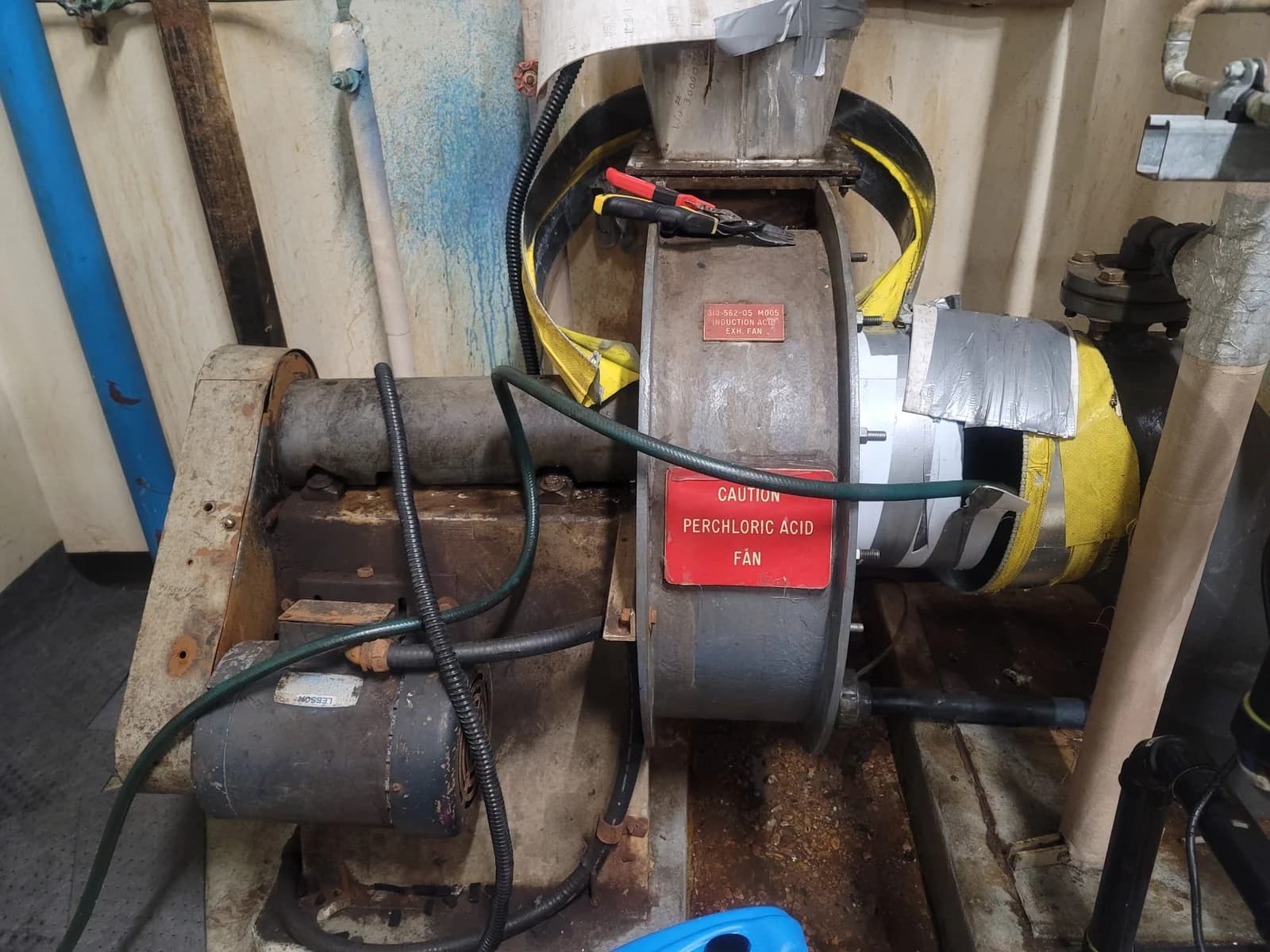
- The fan housing, wheel and shaft seal
- The stack, rain cap and any damper
A washdown system redissolves these salts before they build up. Without one, nothing removes them. NEBB notes that hot perchloric acid used in a hood without internal washdown can leave deposits in the hood, baffles, filters, fans, ducts and exhaust stack.
Which hoods are at risk
Assume a system may hold perchlorates if any of these apply:
- Perchloric acid was heated above ambient temperature in it at any point in its history
- It is a perchloric acid hood whose washdown was skipped, undersized or broken
- A general-purpose hood was used for perchloric digestions, even occasionally
- Its exhaust is manifolded with other hoods that had perchloric use
- Nobody can confirm its chemical history
The last case is common in older buildings. Records go missing, labs change hands, and warning labels fade or come off. If the use history of a hood or exhaust is unknown, treat it as suspect until a qualified assessment defines its condition and the limits of any proposed work.
What the deposits are made of
Perchlorates are salts containing the perchlorate ion. The hazard depends on the compounds present and what else is mixed into the deposit. Some metal perchlorates are shock sensitive, and perchloric acid can form unstable compounds with organic materials. An unknown duct deposit cannot be classified as safe from its appearance or chemical history alone.
Metal perchlorates from duct and fan parts
Condensed acid can attack metal components. Florida State University EH&S identifies copper, brass and bronze as materials that form shock-sensitive salts, and lists aluminum and high-nickel alloys as unsuitable because they dissolve. Corrosion products can become part of the residue mixture.
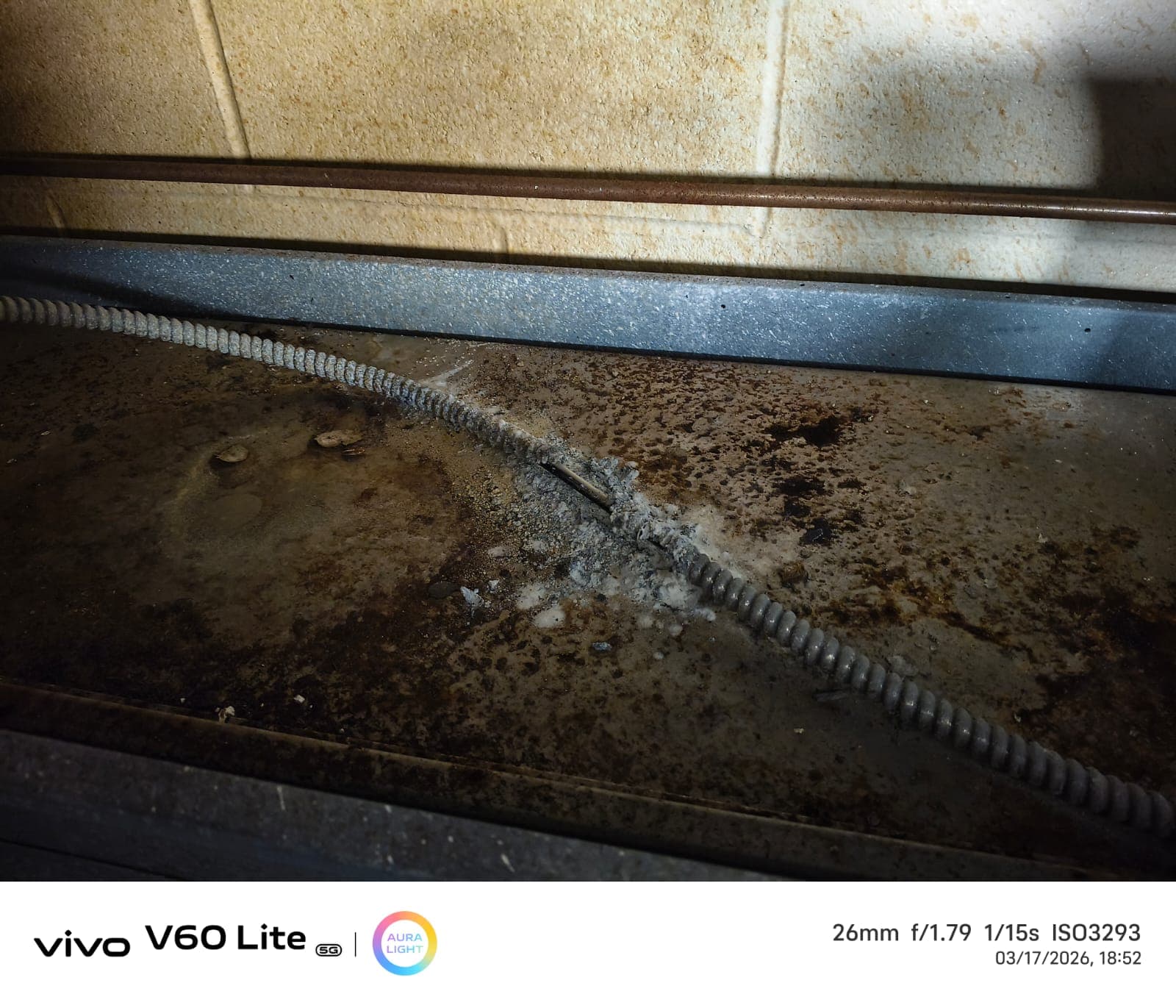
That is why fan wheels, brass fittings, copper tubing and electrical conduit near a perchloric hood all need a look during an assessment. The photo below shows corroded conduit and deposits inside a hood with perchloric acid history.
Organic perchlorates from sealants, lubricants and shared use
Perchloric acid reacts with alcohols and some other organic compounds to form perchlorate esters, which the University of Illinois describes as highly unstable and explosive. Inside an exhaust system, the organic material can come from several places:
- Gaskets, caulking and duct sealants never rated for perchloric service
- Fan bearing grease and belt dressings
- Glycerin-based cements, such as litharge (lead oxide and glycerin) on old stone work surfaces
- Wood, paper, cotton and other cellulose materials stored in or near the hood
- Vapors from organic work in the same hood or a shared exhaust
Mixed use adds uncertainty. A hood that alternated between perchloric digestions and solvent work may contain both perchlorates and organic residues. The assessment must account for both before maintenance or removal.
Explosion risk: what sets perchlorate deposits off
Heat, impact and friction
Labconco's guide says perchlorate crystals can be detonated by heat, flame, friction or impact. No published threshold tells you how much energy a given deposit can take. Composition changes from duct to duct and from one joint to the next, so a safe plan treats every dry deposit as sensitive.
Ordinary maintenance tasks supply exactly those triggers:
- Cutting duct with an abrasive saw or torch
- Drilling or grinding to open an access port
- Hammering, prying or chiseling a seized joint or work surface
- Unbolting flanges that bind and grind as they release
- Welding, heat guns or other hot work nearby
- Running a fan whose wheel rubs against a crusted housing
Water washing is used to dissolve and remove deposits. Its effectiveness depends on reaching the contaminated surfaces and managing the resulting liquid. A wet surface or a completed wash cycle does not establish that the entire exhaust system is ready for maintenance.
Why a shutdown does not remove the hazard
Taking a hood out of service does not remove deposits already inside it. NEBB identifies demolition of contaminated ductwork as an explosion risk when decontamination has not been performed. A renovation or fan replacement therefore needs a contamination assessment even if the hood has been idle for years.
Materials that make the problem worse
The FSU guideline lists materials that are and are not suitable for use with 72% perchloric acid. It is a useful checklist for a walkdown of an older system.
| Group | Materials |
|---|---|
| Avoid: forms shock-sensitive salts | Copper, brass, bronze |
| Avoid: dissolves | Aluminum, high-nickel alloys |
| Avoid: organic or cellulose-based | Wood, cotton, wool, cellulose-based lacquers, vegetable-based Micarta, litharge (glycerin and lead oxide) cement |
| Avoid: plastics and resins | Nylon and other polyamides, polyester (Dacron), modacrylic (Dynel), Bakelite, Lucite |
| Generally suitable | PVC, PTFE (Teflon), polyethylene, polypropylene, Kel-F, vinylidene fluoride, Viton, epoxy resins, glass, glass-lined steel, alumina, tantalum, titanium, zirconium, niobium, Fluorolube |
Testing for perchlorate residues before maintenance
NFPA 45 (2024 edition) sets the rule in Section 7.12.10. If a hood or exhaust system was used for perchloric acid heated above ambient temperature, tests for explosive perchlorates must be done before any inspection, cleaning, maintenance or other work on any part of the exhaust system or hood interior.
The assessment team selects sampling and analytical methods for the proposed work. Field color tests have important limitations; quantitative laboratory results also apply only to the samples and locations assessed.
Methylene blue spot test
Methylene blue has historically been used as a color test for perchlorate in surface rinses. Other chemicals in the sample can interfere with the result. NEBB reports both false positives and false negatives and advises against relying on this test to assess a hood's contamination status.
A negative spot test is not clearance
Neither a negative color test nor a single laboratory result clears an entire duct system. A qualified assessor and your EHS team must review the sampling coverage, analytical limits and proposed activity. Record inaccessible areas and any restrictions before authorizing work.
Diphenylamine test for oxidizing residues
The diphenylamine test described by FSU uses an acidic reagent to detect oxidizing residues. It can also react with other oxidizers, including nitrates, so a color response does not identify or quantify perchlorate. Reagent selection and handling belong in the specialist's sampling procedure.
Laboratory analysis: EPA Method 6850, ion chromatography and ion-selective electrodes
Quantitative results come from swab or rinse samples sent to a laboratory. NEBB describes swabbing the heaviest deposition points in the hood and stack inside a template of known area, so results can be reported per unit area. Field blanks and background samples belong in every sample set.
| Method | Technique | Notes |
|---|---|---|
| EPA Method 6850 | HPLC with electrospray ionization mass spectrometry (MS or MS/MS) | EPA-validated for perchlorate in water, soils and solid wastes. NEBB cites it for hood and duct samples. |
| Ion chromatography | Chromatographic separation and detection of perchlorate | The laboratory must select a method and preparation suitable for the rinse, swab extract or other sample matrix. |
| Ion-selective electrode | Perchlorate-specific electrode | A screening option whose interferences and reporting limits must be assessed for the sample matrix. |
Agree on reporting limits, sampling coverage and work-specific acceptance criteria with the laboratory, qualified assessor and EHS team before sampling. A result below a reporting limit means perchlorate was not measured above that limit in that sample; it does not prove that no residue exists elsewhere in the system.
Design standards for perchloric acid hoods
Most perchloric acid hood specifications in North America draw on NFPA 45, ANSI/ASSP Z9.5 and the ACGIH Industrial Ventilation manual. Your jurisdiction, institution and insurer may add their own requirements.
What NFPA 45 Section 7.12 requires
NFPA 45, Standard on Fire Protection for Laboratories Using Chemicals, has a section on perchloric acid hoods. In the 2024 edition it is Section 7.12. Older editions number it differently (8.11 in the 2004 edition), so check which edition your jurisdiction has adopted. Paraphrased, the 2024 requirements are:
- Perchloric acid heated above ambient temperature may only be used in a hood designed for it and labeled FOR PERCHLORIC ACID OPERATIONS. The exception is a setup where the vapors are trapped and scrubbed before they reach the hood.
- Hood and ductwork materials must be acid resistant, nonreactive and impervious to perchloric acid.
- The exhaust fan must be acid resistant and spark resistant. The fan motor and drive belts stay out of the ductwork, and belts must be conductive.
- Ductwork takes the shortest, straightest path outdoors and is not manifolded with other exhaust. Horizontal runs stay short with no sharp turns, ducts drain back toward the hood, sections are sealed, and flexible connectors are not allowed.
- Sealants, gaskets and lubricants must be acid resistant and nonreactive with perchloric acid.
- A water spray system washes down the hood interior behind the baffle and the entire exhaust system. The work surface is watertight with a 13 mm (1/2 in.) depression at the front and sides, and a trough at the rear collects washdown water.
- The baffle is removable for inspection and cleaning.
- Hoods and exhausts used with heated perchloric acid must be tested for explosive perchlorates before any work (7.12.10).
- A perchloric acid hood must be water-washed and tested before it is used for any purpose (7.12.11).
The annex adds that perchloric acid hoods should be washed down after each use.
ANSI/ASSP Z9.5 and the ACGIH Industrial Ventilation manual
Z9.5 is the American National Standard for laboratory ventilation. Older references cite ANSI/AIHA Z9.5. The current edition is ANSI/ASSP Z9.5-2022, and AIHA's summary of it lists perchloric acid hoods among the special hoods it covers, along with gloveboxes and ductless hoods.
The ACGIH Industrial Ventilation manual gives the most concrete construction guidance. Its perchloric acid hood data sheet (VS-35-03 in the 27th edition) prefers Type 316 stainless steel with welded joints and accepts unplasticized PVC or an inorganic ceramic coating such as porcelain. It also calls for an individual exhaust system for each hood, fluorocarbon grease on the fan, the fan outside the building, and a vertical discharge stack.
Type 316 stainless steel and welded construction
NFPA 45 does not name a material. It sets a performance requirement: acid resistant, nonreactive and impervious. Specifications usually meet it with Type 316 stainless steel, unplasticized PVC, or PVC as a liner in stainless for lighter duty. Labconco's guide prefers Grade 316 over 304 stainless.
Construction details matter as much as the alloy:
- Welded seams and a one-piece liner with coved corners, so salts have no cracks to collect in
- A dished, liquid-tight work surface with a rear trough
- Duct sections welded, or joined with 316 stainless screws and nonreactive gaskets where welding is not possible
- Horizontal runs sloped back toward the hood, at least 1 in. per ft in the FSU guideline
- Fan wheels coated with PTFE or PVC, or made from another compatible material
- Shatterproof sash glazing
Washdown design and airflow
A washdown system only works if water reaches every surface where vapor condenses. Labconco recommends wash rings at the stack outlet, before and after each elbow, every 8 to 10 ft of vertical duct, every 2.5 to 5 ft of horizontal duct, before and after the blower, and just above the hood.
For cycle time, Labconco cites typical standards of 10 to 30 minutes after each use and favors several short runs over one long one. On staged systems it runs the top stage with the blower on for about a minute, then with the blower off for about 30 minutes, and works down the duct one stage at a time. Water sprayed with the blower running stays suspended in the duct until the blower stops.
NFPA 45 Section 7.12 does not set a face velocity for perchloric hoods. Performance criteria come from your ventilation program. Labconco designs its perchloric hoods to 100 fpm at the worst-case sash position, which matches many institutional standards. ASHRAE 110 containment testing evaluates the installed hood's ventilation performance; it does not assess chemical contamination.
Planning perchloric acid decontamination and dismantling
These seven phases describe the decisions and records an owner or EHS team should expect. The specialist must develop the actual treatment, access, isolation and dismantling methods for the system's condition and the intended work. Routine manufacturer washdown instructions are not a dismantling procedure for a contaminated legacy system.
Do not open a suspect system to inspect it
Cutting, drilling, unbolting a joint or removing a baffle or access panel can disturb contamination. Initial assessment must use records and views through openings already available without moving components. Any further access requires the specialist's documented controls and authorization for that task; washing alone does not provide that authorization.
Phase 1: Records review and risk assessment
Start with paper, not tools. Gather:
- Chemical use history: who used perchloric acid, at what concentration, heated or not, and for how long
- Washdown records and the condition of the washdown system
- As-built drawings showing duct routing, materials, joints, the fan and the stack
- Whether the exhaust is shared with other hoods
- Previous assessments, spills or incidents
The assessor uses those records to define the suspected contamination, accessible areas, sampling scope and controls. Unknown history must remain an explicit uncertainty. A risk classification does not authorize intrusive inspection or removal.
Phase 2: Non-intrusive assessment and sampling plan
Review only surfaces already visible through existing openings without moving the sash, baffles, access panels or other components. Where surfaces cannot be seen or sampled without disturbing the system, record the limitation and have the specialist define the controls needed for further access.
- Identify representative locations, likely deposition points and inaccessible sections on the system drawings.
- Agree on sampling methods, field blanks, laboratory methods and reporting limits before collection.
- Document how samples can be collected under the site-specific controls without unplanned disturbance.
- Record each sampled location and the parts of the system that the results cannot represent.
Appearance alone cannot establish contamination status. Clean-looking stainless can carry residue, and white deposits may contain other salts. Sampling itself is controlled work and must be planned by the assessment team.
Phase 3: Isolation and site controls
- Coordinate occupancy restrictions, exclusion areas and access to the lab, fan location and roof.
- Define ventilation and energy-isolation requirements for each stage, including electrical hazards during wet treatment.
- Confirm water supply, duct integrity, containment and collection of runoff before treatment.
- Have the specialist select chemically compatible equipment, tools and protective measures for the assessed hazards.
- Document responsibilities, communication and the conditions that require work to stop.
Phase 4: Wet decontamination
The treatment plan must account for the whole connected exhaust path and the ability to reach contaminated surfaces. NEBB describes extensive water flushing, with the protocol designed for each system to address access and leakage risks.
- Define treatment coverage for the hood, duct runs, joints, fan and stack, including areas the installed washdown system may not reach.
- Distinguish routine manufacturer washdown cycles from the treatment needed for existing deposits.
- Set treatment duration and repeat cycles from the system assessment and verification results.
- Plan collection, characterization and disposal of wash water before it is generated.
Phase 5: Verification and authorization for the next task
The assessor reviews post-treatment results against the agreed criteria, sample locations, analytical limits and intended next task. Further treatment or investigation may be needed where results do not meet the criteria or coverage is incomplete.
Results from accessible surfaces do not establish the condition behind joints, inside a fan or in unsampled duct sections. The work authorization must identify those uncertainties, remaining controls and the specific activities permitted. Completion of a wash cycle is not a release for cutting or dismantling.
Phase 6: Specialist-controlled dismantling
Dismantling proceeds only under a written plan developed by the qualified specialist and reviewed with the facility's EHS team. The sequence depends on contamination, access, structural support, energy isolation and the results obtained. There is no universal fan-first removal sequence suitable for every system.
- Specify the controls and verification needed before each joint, fan or duct section is disturbed.
- Address residual contamination exposed as components are separated, including wet methods where the specialist determines they are appropriate.
- Define handling, containment and assessment of removed components before transport or disposal.
- Stop and reassess if unexpected deposits, damaged components or conditions outside the plan are encountered.
Phase 7: Waste handling and handover records
Wash water and removed components may contain perchlorate, acids and metals. Their disposal route must follow characterization, applicable local requirements and the receiving facility's acceptance criteria. A washed appearance or a negative sample from another component does not establish that an item is uncontaminated waste.
The handover package should record:
- The system and areas included
- Wash methods, durations and dates
- Sample locations, methods and results, including blanks
- Areas that could not be reached or tested
- Waste quantities and disposal records
- The activity authorized, acceptance criteria and any restrictions on reuse or further work
If a perchloric acid hood is going back into use, for any purpose, NFPA 45 Section 7.12.11 requires it to be water-washed and tested for residual perchlorates first.
Planning work on a hood with perchloric history
The question usually comes up during a renovation, a fan replacement or a lab closure. Start the assessment before the contractor schedule is fixed. Sampling, washing and re-testing take days, and laboratory turnaround adds more.
Fume Hood Experts provides perchloric acid decontamination for laboratory maintenance, renovations and equipment removal. Send us the chemical history, existing photos of the hood, fan and stack, and your schedule. We will recommend the assessment and treatment scope.
Common questions
Need a more specific answer?
Talk to our team
Can perchloric acid be used in a regular fume hood?
Not when it is heated. NFPA 45 Section 7.12.1 limits perchloric acid heated above ambient temperature to hoods designed and labeled for perchloric acid operations, unless the vapors are trapped and scrubbed before they reach the hood. Many institutions allow small amounts of cold perchloric acid, at 72% or less, in a standard chemical hood. Your EHS program sets the limits.
How often should a perchloric acid hood be washed down?
After each use. The NFPA 45 annex recommends washdown after each use, and the FSU guideline says at least daily after use. Labconco cites typical cycles of 10 to 30 minutes and finds several short runs work better than one long run.
Is a methylene blue test enough to clear a duct for cutting?
No. NEBB reports both false positives and false negatives from methylene blue testing. Laboratory results support assessment of the locations sampled, but do not clear inaccessible or unsampled parts. A qualified assessor and your EHS team must review the evidence and authorize the specific work under a written plan.
What does perchlorate contamination look like?
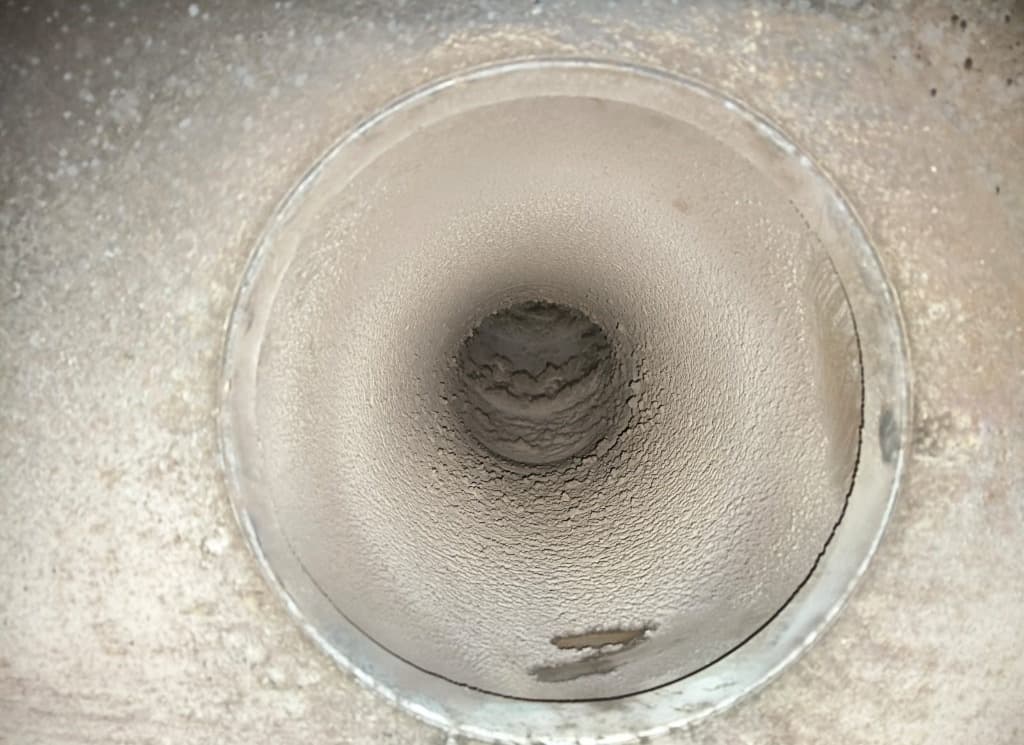
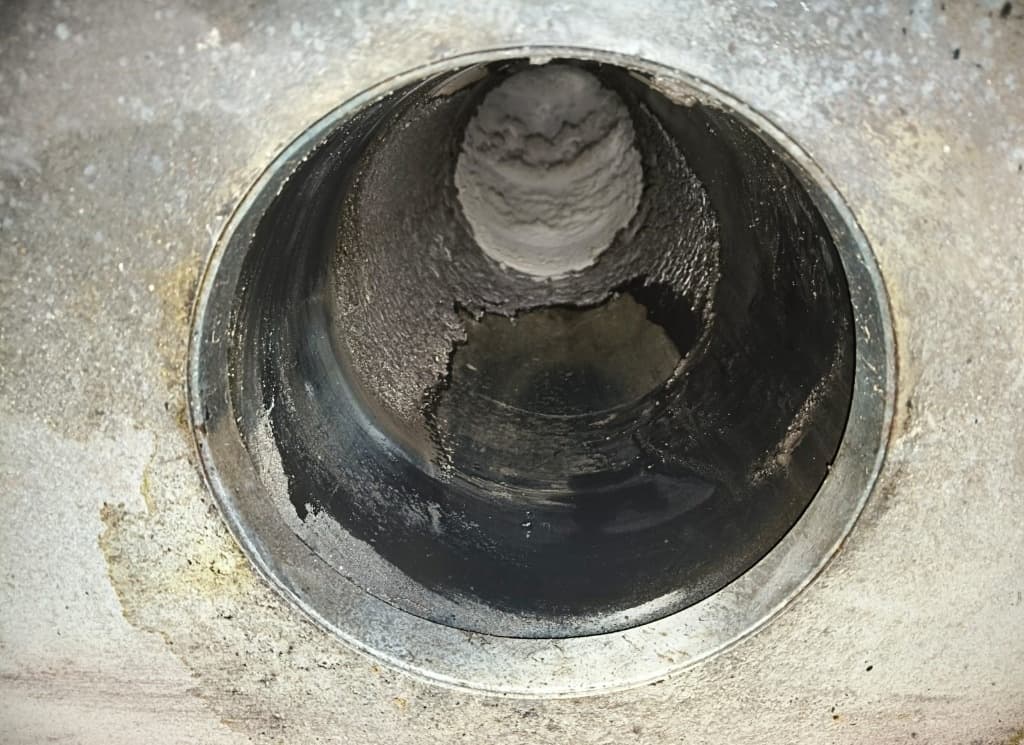
It may appear as white or crystalline crusts at joints, elbows, baffles and fan housings. Appearance cannot establish contamination status: clean-looking surfaces can carry residue, and white deposits may contain other salts. Assessment and appropriately planned sampling are needed.
How long does perchloric ductwork decontamination take?
NEBB describes extensive water flushing over at least 24 hours, with the protocol designed for the particular system. This is not a universal treatment time or completion criterion. Records review, controlled access, sampling, laboratory turnaround, repeat treatment and any dismantling add time; the assessed scope and results determine the schedule.
Can a former perchloric acid hood be reused for other work?
Water washing and testing are required under the cited NFPA 45 provision. Reuse also needs an EHS review of the results, their coverage, the equipment's suitability and the proposed process. A negative result from one surface does not release the whole hood and exhaust system for another use.
Sources
- NFPA 45: Standard on Fire Protection for Laboratories Using Chemicals (2024), Section 7.12 (opens in a new tab). National Fire Protection Association.
- Perchloric Acid Fume Hood Mechanical Systems (opens in a new tab). Labconco.
- Guidelines for Using Perchloric Acid (opens in a new tab). Florida State University EH&S, adapted from Harvard University.
- Perchloric Acid (opens in a new tab). University of Illinois Division of Research Safety.
- A Complete Guide to Perchloric Acid Testing (opens in a new tab). NEBB.
- Validated Test Method 6850: Perchlorate in Water, Soils and Solid Wastes Using HPLC/ESI/MS (opens in a new tab). US EPA.
This article is general safety information, not a site-specific work procedure. Follow your EHS program, the code editions your jurisdiction has adopted and a written plan before work starts.